In this guide
At a glance
- Two separate choices
- Cutting system and wheel propulsion
- Manual reel
- Best considered for manageable, regularly cut lawns
- Check first
- Grass height, terrain, access and storage
- Safety
- Read the manual and keep guards intact
A mower can be simple without being the right kind of simple for your lawn. A light manual reel mower may be pleasant on a small, level patch and frustrating on a rough area you cut infrequently. A powered mower may solve one problem while creating another if it is too heavy to lift through the gate.
Start with the grass and the route around it. The most useful choice is the machine you can operate, maintain, and store comfortably, with a cutting range that suits the lawn rather than an impressive list of features.
Separate the mechanism from the propulsion
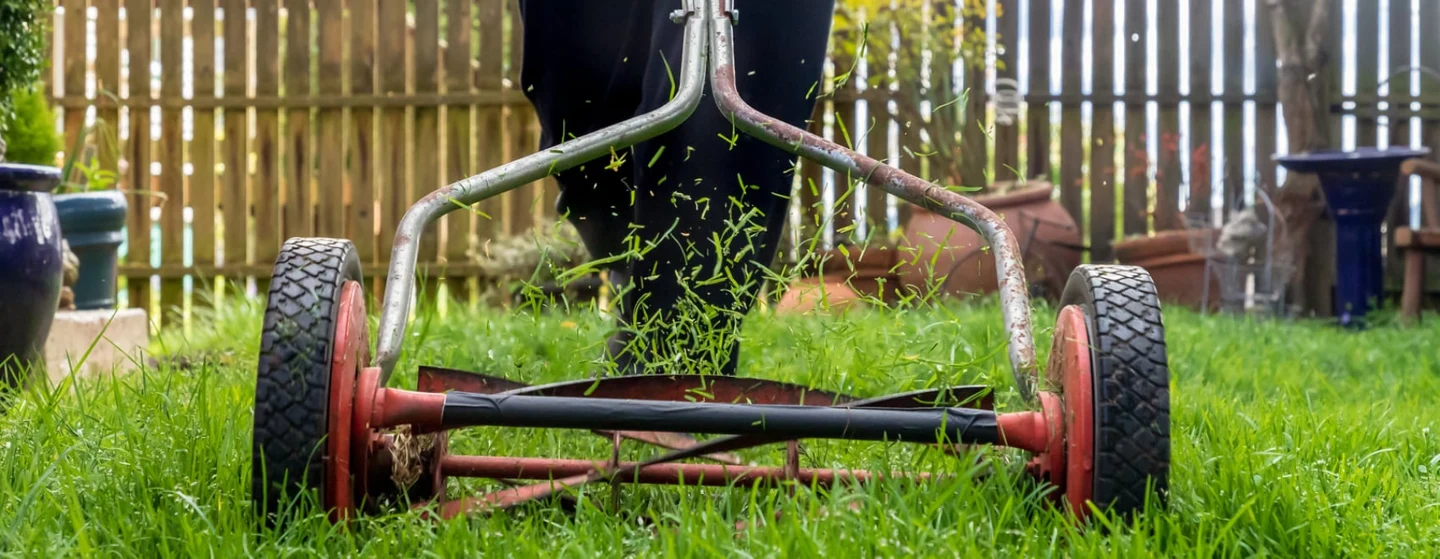
Reel and rotary describe how a mower cuts. A reel mower has rotating blades working against a stationary bedknife, rather like scissors. A rotary mower uses a horizontally rotating blade. Both need sound, correctly maintained cutting edges to produce a good result.
Push and self-propelled describe how the mower moves. You supply the forward force to a push mower; a self-propelled machine provides powered assistance to its wheels. A push mower can therefore be a manual reel or a powered rotary machine. It is not correct to use push mower as a synonym for every hand-powered reel mower.
Power source is another decision. Corded electric, battery, and petrol machines have different handling and maintenance requirements. Decide which practical arrangement works before comparing individual models.
Assess the actual mowing job
Note the lawn's area, slopes, uneven ground, narrow passages, and obstacles. Measure gates and storage openings. Consider where you will turn and whether the mower needs to be carried up steps. A wider cutting deck reduces the number of passes in an open area but can become awkward around small beds.
Think about the grass height you want to maintain and how often you will mow. Many reel systems work best with regular cutting and can struggle with long, coarse, or debris-strewn growth. Check the adjustment range against guidance for your grass and its growing conditions.
There is no universal area below which everyone should choose a manual mower. Your strength, available time, terrain, and tolerance for the work matter. Try the handling if possible rather than relying on a promised number of minutes for an imaginary lawn.
Where a manual reel makes sense
A manual reel mower avoids a motor, fuel, a battery, and a trailing cable. Its appeal is the direct relationship between your walking pace and the work, with relatively little equipment to organize before starting.
That does not mean zero effort or no maintenance. Blades need suitable adjustment and sharpening, moving parts need care, and sticks or stones can interfere with the cutting unit. Collect debris before mowing, and arrange servicing that suits the particular mechanism.
Consider it when the lawn is modest, reasonably smooth, and cut regularly at a suitable height. If you frequently return to long grass after time away, the simplest-looking machine may make the job more demanding rather than less.
Compare powered options around your routine
A corded machine needs a safe electrical setup and cable management appropriate to outdoor work. A battery machine needs sufficient usable runtime and a convenient charging and storage arrangement. A petrol machine adds engine servicing, fuel handling, exhaust, and more equipment to maintain.
Self-propulsion can reduce the force needed to move a heavier machine, but it does not eliminate steering, turning, or transporting it. Check control comfort and whether the speed feels manageable. A machine should suit the person who uses it most often, not just the strongest person available for a demonstration.
Also consider collection, discharge, and mulching arrangements. They affect the number of interruptions and how you deal with clippings. No system makes it sensible to cut very long or wet growth in one rushed pass.
Work back from the grass height, not the collection day
Before comparing cutting widths, establish the height your lawn should keep. Regional and grass-species guidance comes first: a fine warm-season lawn and a typical cool-season Midwest lawn are not maintained to one universal setting. A mower that cannot reach the appropriate height is the wrong fit, even if it is light and easy to store.
Minnesota Extension advises removing no more than one-third of the leaf height at a mowing. That gives a useful calculation once the target is known. For its typical three-inch Midwest lawn example, mowing before the grass exceeds four and a half inches removes at most one and a half inches. The relationship is the point; three inches is not a recommendation for every grass around the world.
For a target height H, the one-third rule means the pre-cut height should be no more than 1.5 × H if you want to reach the target in that cut. This is a planning limit, not a direction to force an overgrown lawn down to height in one pass. After an absence, reduce height gradually in suitable conditions rather than scalping it because the mower has returned from the shed.
That relationship changes the equipment decision:
- If you mow little and often on an even, manageable lawn, a suitable manual reel may fit the routine.
- If long gaps between visits are unavoidable, check how the chosen system handles the growth you actually expect; do not buy around an ideal weekly schedule you cannot keep.
- If the machine's height range excludes the local recommendation, another model or cutting system deserves consideration before a wider deck.
Short, evenly distributed clippings from regular mowing can be left to decompose where appropriate. A mulching attachment does not mean you can extend the interval indefinitely; large clumps still need attention. Follow any pesticide label restrictions before moving treated clippings to compost or other beds.
A quick note of the date and growth between cuts soon reveals whether your schedule matches the lawn. That is a better basis for choosing a mower than a promised area-per-hour figure that ignores the grass height.
Cut well and keep the equipment safe
Use the mowing height and frequency appropriate for the grass and season. Keep cutting edges sharp; a dull rotary blade can tear the leaf tips. Follow the mower manual for maintenance rather than applying one sharpening or lubrication routine to every design.
Inspect the area, keep people and pets clear, and never remove or defeat guards or safety controls. Isolate the power source as instructed before clearing blockages, cleaning the cutting area, or making adjustments. A stopped blade is not by itself a safe maintenance procedure.
Choose the mower that makes those habits easy to keep. Quiet operation, tidy storage, and a good cut are more useful in everyday life than a machine chosen mainly because it sounded powerful on the specification sheet.
Sources & further reading
This guide draws on horticultural and specialist references. Conditions vary with climate, cultivar, and site.
- University of Minnesota Extension: mowers and mowing safety
- OSHA: landscape equipment hazards
- University of Minnesota Extension: mowing height, one-third rule and clippings