In this guide
At a glance
- Start with
- One scene and compatible plants
- Container
- Drainage and root space
- Care
- Depends on the plants
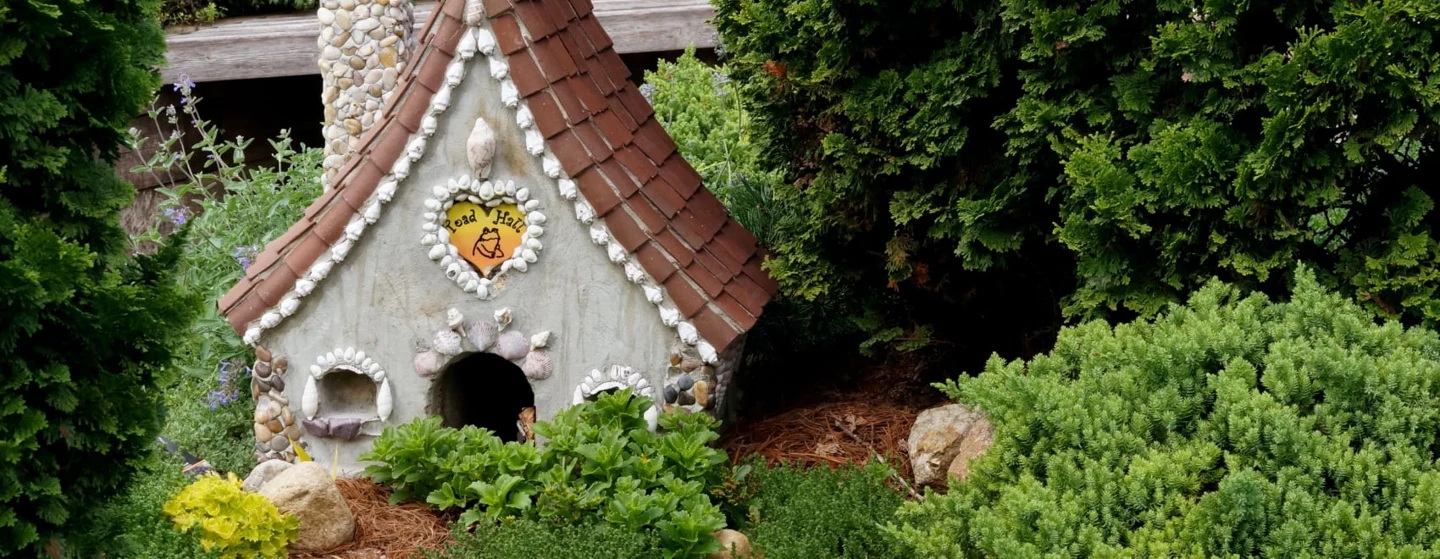
A fairy garden is a small planted scene with room for a story. A path of pebbles can lead to a tiny door, or a low plant can become a tree beside a miniature seat. The most convincing versions leave enough space for the plants to be part of the setting. You do not need a full collection of accessories. Begin with one simple idea and a container you can look after, then let the living part develop.
Choose the place before the miniature world
Decide whether the garden will live indoors or outside. Check light, exposure and the temperatures it will experience. An indoor tabletop, an open terrace and a shaded outdoor corner are different growing environments; choose the plants accordingly.
Put the scene somewhere you can see its small details and reach it for care. If children will use it, make the arrangement suitable for their age and access, including the choice of plants and small loose pieces. Keep the container stable. A miniature garden should invite attention without becoming something that has to be rescued from the edge of a shelf.
Give the plants a functional container
Use a container with drainage and enough root space for the selected plants. If you want a decorative outer vessel, keep a practical growing container inside it and check for collected water. A closed teacup is not automatically suitable just because the scene fits.
Choose a potting medium appropriate to the plants. Do not treat a decorative layer of stones as a replacement for functioning drainage. Keep the working arrangement simple enough that you can water the roots and let excess water escape without moving every tiny feature. The easier this is, the more likely the scene is to remain a garden rather than a display of struggling plants.
Build around compatible plants
Choose plants with similar light, moisture and temperature needs. Use modest growth habits and allow for their eventual size. A plant sold small may soon overwhelm the scene, so check what it is rather than assuming every miniature-looking specimen will remain miniature.
Give different shapes clear roles: a low carpet beside the path, one more upright form near the tiny house, and an open area where the eye can rest. Avoid mixing plants purely for visual contrast if their care conflicts. A smaller coherent planting will usually be easier to manage and more believable at this scale.
Plan the living parts at their future size
Illinois 4-H treats a miniature garden as a planting design: a small group of plants with similar growing needs, planned with attention to scale, texture and colour. The important word is plants. A small specimen is not necessarily a miniature species, and a miniature label does not promise growth will stop.
For an illustrative 35-centimetre-wide bowl, draw the spread expected from each chosen plant before marking the path. Two suitable plants may leave a more convincing clearing than six seedlings that quickly crowd the house. Keep demanding combinations in separate pots hidden within a larger scene only if each can still drain and receive its own care. Check their moisture separately. A concealed pot is a way to organise plants, not a reason to ignore their roots.
Keep the story readable
Choose one focal feature and build a short relationship around it. A door with a path leading toward it tells a clearer story than several unrelated buildings pressed together. Repeat a material, such as small stones or weathered wood, so the pieces feel connected.
Use accessories that suit the conditions and can be removed for maintenance. Loose material should not fall into drains or spread around the garden. If the scene is outside, consider what rain, wind and ordinary watering will do to it. A feature that looks delicate does not have to be difficult to keep in place.
Make one small scene feel intentional
Choose one viewpoint and one event: a doorway beside a path, a bench beneath a plant, or a tiny landing at the edge of a clearing. Put the strongest detail where it is easily seen, then leave open ground around it. A path that ends behind the main feature suggests more of a world than a collection of unrelated ornaments covering the soil.
Keep the scale reasonably consistent. If a miniature door is 5 centimetres tall, a bench taller than that door will usually read as a different scale. You do not need model-making accuracy, but one repeated relationship makes the scene easier to understand. Test the composition with paper cutouts before buying or fixing anything.
Allow for the gardener's hand as well as the imagined inhabitants. Leave somewhere to direct water onto the growing medium, lift a plant and remove fallen leaves. Loose bark and pebbles will shift when watered; delicate furniture should be removable for maintenance. For a project shared with children, choose age-appropriate materials and supervise small loose objects rather than treating miniature pieces as automatically suitable toys. Photograph the initial arrangement so restoring a knocked-over scene is a pleasant small task, not a reconstruction project.
Know when a terrarium is a different project
A glass vessel can be attractive, but it creates a particular environment. Closed terrariums are suited to plants that tolerate their humid conditions; they are not a general substitute for an open pot. Choose a planting approach appropriate to the vessel and avoid adding a mixture of incompatible plants.
If moss is part of the scene, use responsibly sourced material suited to the conditions. Preserved decorative moss is not the same as living moss. Do not collect from wild places to complete the display. A simple open container is often a more manageable first project than trying to combine a tiny landscape with an unfamiliar enclosed growing system.
Leave room for the scene to change
Water according to the plants and compost, rather than a calendar for “fairy gardens” as a group. Check for pests and remove unwanted growth while you can still reach it. Trim only where appropriate to the plant, and replace anything that has outgrown the arrangement.
Keep the pieces movable. Changing the path or shifting a small seat can make the garden interesting again without buying more accessories. The plants will supply enough change of their own. A miniature scene is most enjoyable when its story can develop while the practical gardening remains straightforward.
Sources & further reading
This guide draws on horticultural and specialist references. Conditions vary with climate, cultivar, and site.
Our editorial standards →